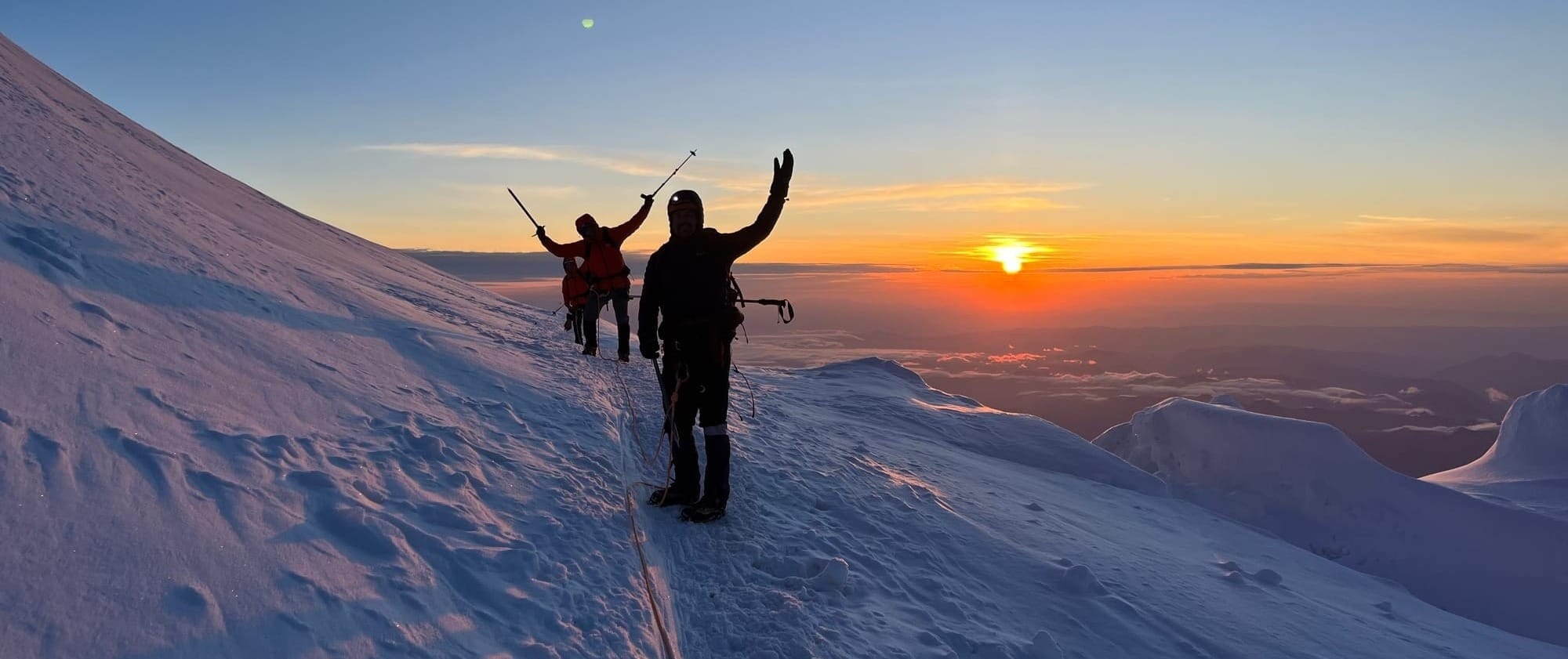
Choosing your first mountaineering objective can be daunting. Mount Baker and Mount Rainier are both excellent places to start, and both are real mountains that ask real things of you. Neither is a warmup for the other. They ask for different things, and understanding what each one demands is the fastest way to figure out which fits where you are right now.
Here is how they compare, and how to think about the decision.
The short version
| Mount Baker | Mount Rainier | |
|---|---|---|
| Summit elevation | 10,781 ft | 14,410 ft |
| Vertical gain, summit push | ~5,500 ft | ~9,000 ft |
| Summit day length | 10 to 12 hours | 13 to 15 hours |
| Approach to high camp | 4 to 5 hours | 4 to 6 hours |
| Where you sleep | Tents on the glacier | Climber's hut at Camp Muir, or tents |
| Glacier travel | Yes, roped, with crevasse rescue | Yes, roped, with crevasse rescue |
| Altitude as a factor | Minimal | Significant |
| Program length | 3 or 6 days | 4, 5, or 6 days |
The table tells you the numbers. It does not tell you what the days actually feel like, which is where the real difference lives.
Mount Baker
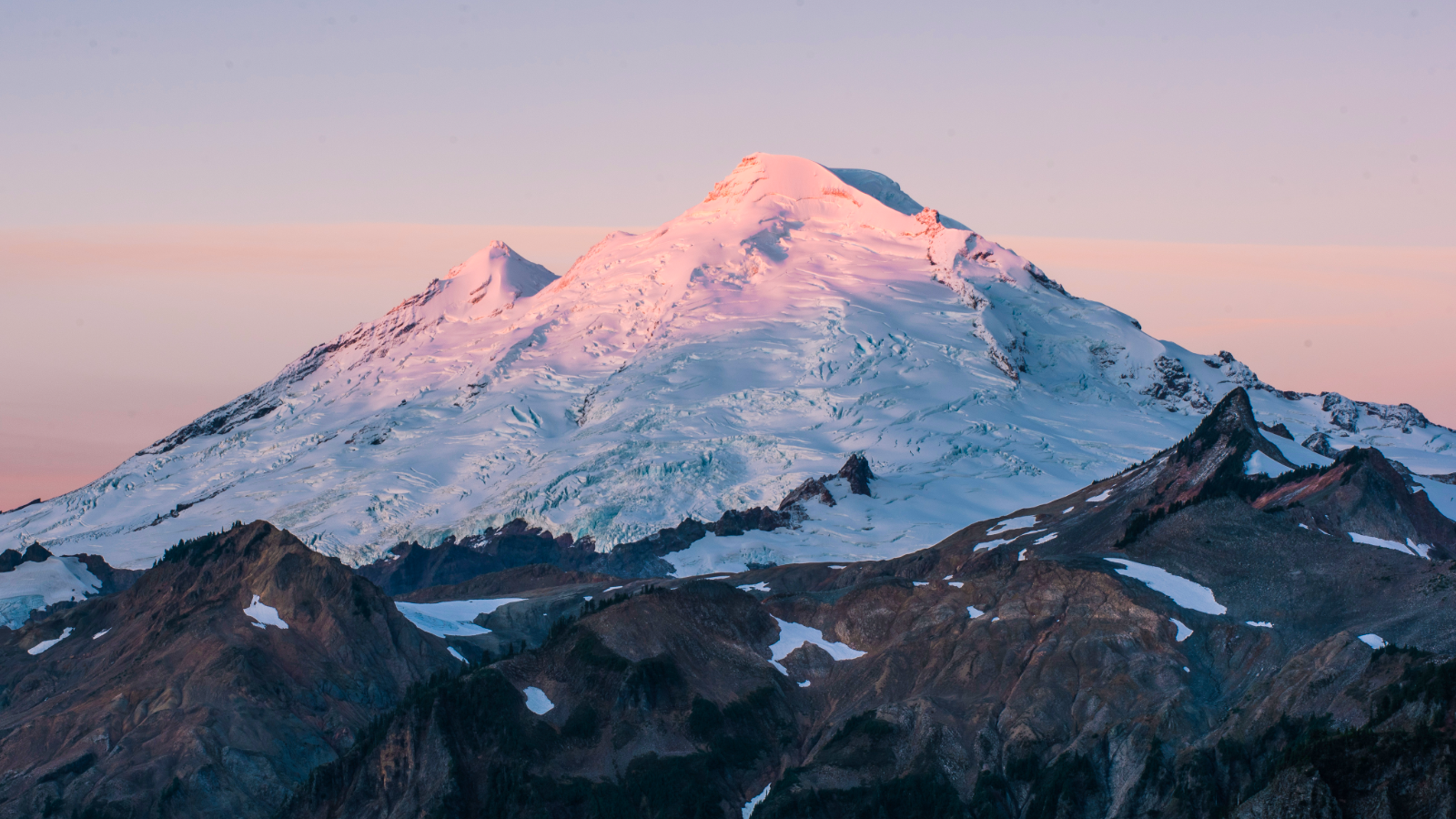
Baker is a serious glaciated peak with a personality of its own. It sits close to the Pacific, which means it catches weather early and often. The glaciers are deep and active, with icefalls and crevasse fields that require ropes, ice axes, crampons, and the training to use all three. What you learn on Baker is not a simplified version of glacier travel. It is glacier travel.
The biggest measurable difference between the two mountains is elevation. Standing on Baker's summit puts you at roughly the height of Rainier's high camp. Altitude affects the body on Rainier in ways it simply does not on Baker.
What Baker asks for instead is self sufficiency. You are living on the mountain, not stopping at a hut.
What Baker teaches you:
- Camp craft on a glacier, including tent siting, anchoring, and snow walls
- Melting snow for water and managing a stove in wind
- Multi day pack management and load carrying
- Roped travel, crevasse rescue, and route finding on active ice
- What your body does on day three, not just day one
That skill set is the foundation for everything that comes after. It is also why climbers who start on Baker tend to find their next objective more manageable.
Baker programs
Mt. Baker - Easton Glacier is a 3 day program that includes all the training you need for a fun and adventurous summit attempt.
Expedition Skills Seminar - Baker: Coleman-Deming is a 6 day program with a summit attempt plus the training to take on glaciated peaks like Mt. Rainier and Denali.
Mount Rainier
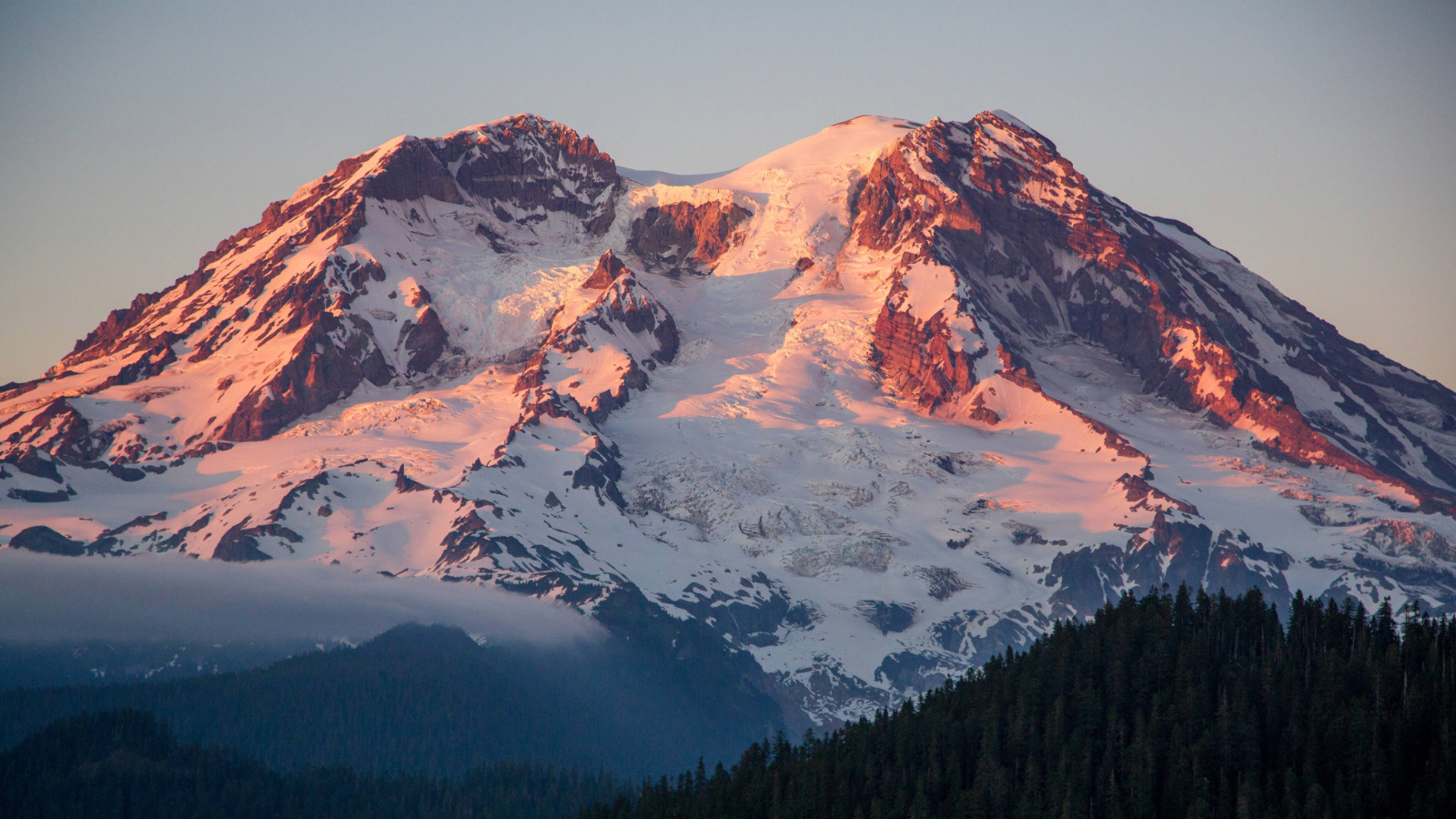
As the tallest mountain in Washington and the most glaciated peak in the lower 48, Mount Rainier has served for generations as the training ground for bigger and more technical climbs around the world. Climbers come here before Denali, before Aconcagua, before the Himalaya.
Rainier is the larger and more technical of the two:
- Bigger terrain features and steeper average slopes
- Crevasses that grow through the season, with some crossings requiring ladders
- Long rocky sections that are not technical but are absolutely arduous
- Real altitude on a summit day that already runs 13 to 15 hours
Our Rainier programs are built around that reality. You get an afternoon or full day orientation, a complete day of Snow School, and a 4 to 6 hour approach to high camp. The Four Day Climb and Five Day Climb gain 9,000 vertical feet and cover 18 miles round trip over the summit attempt. Programs going through Camp Muir spend the night in our climber's hut at 10,000 feet. Programs elsewhere on the mountain use tents.
RMI has a long track record of guiding first time climbers to the summit of Rainier, with comprehensive training built into every program before the summit attempt. If you are a fit athlete who likes long endurance days, Rainier is a legitimate first climb.
Rainier programs
Four Day Climb and Five Day Climb include all the necessary training for a successful summit attempt.
Expedition Skills Seminar - Paradise is a 6 day program with a summit attempt and the training for independent climbs like Baker or guided climbs like Denali.
Training matters more than the mountain you choose
Fitness is the single biggest predictor of how your climb goes. Both mountains demand endurance. Both put you on your feet for a very long day at altitude with a pack on, on terrain that does not let you check out.
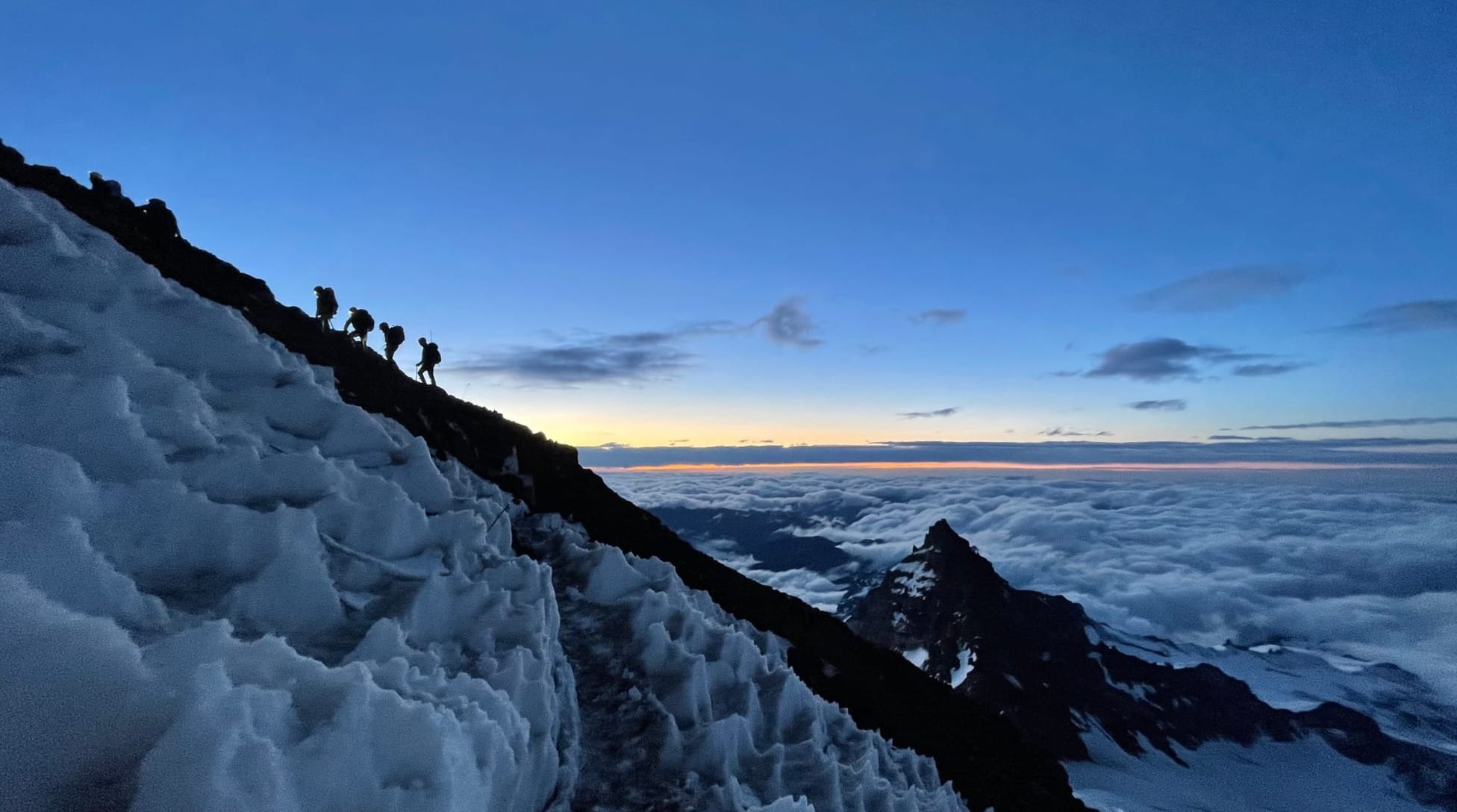
Whichever you pick, the preparation looks similar:
- Aerobic base. Long, sustained, conversational-pace effort. This is the bulk of the work.
- Loaded hiking. Uphill, with weight, on real terrain. Stairs and treadmill inclines count when the terrain does not.
- Consistency over intensity. Months of steady training beats a hard six weeks.
- Time on your feet. Back to back long days replicate what summit day asks for better than any single workout.
For the full breakdown, start with our Fitness and Training page.
Timing your climb
Season shapes both mountains, and it shapes them differently.
Baker's window runs from late spring through summer. Earlier in the season means more snow coverage, better crevasse bridging, and a more straightforward walk. Later means more exposed ice and more route finding.
Rainier's season runs late spring into September. The same pattern applies but with more consequence: as summer progresses, crevasses open, the route lengthens, and rocky sections that were buried in June become long stretches of loose ground in August. An early season Rainier climb and a late season Rainier climb are meaningfully different experiences on the same mountain.
 Kristian Whittaker
So which one?
There is no wrong answer, but there is a right answer for you.
Baker makes sense if:
- You want to build the full expedition skill set from the ground up
- You want camp craft and glacier living, not just a summit push
- You are pointed at Rainier eventually and want to arrive already knowing how your body handles a rope team and a heavy pack
- You have a shorter window and want a 3 day program
Rainier makes sense if:
- You already have a strong endurance base and like long days
- The bigger objective is what is actually pulling at you
- You are pointed toward Denali or another major expedition and want the closest analog in the lower 48
- You want the mountain that has been the American proving ground for over a century
Either works if you are willing to train for it. That is the real gate, not the mountain.
A note on order
The path is not a ladder with one direction. Plenty of climbers do Baker first and go to Rainier the following season. Plenty go straight to Rainier and do great. And plenty summit Rainier, get hooked, and come back for a Baker seminar because they want the deeper skill work that a summit climb does not have time to cover.
Whichever way you go, you will be trained, equipped, and climbing with guides who have done it hundreds of times. That part does not change.
Questions about which program fits you best? Reach out