

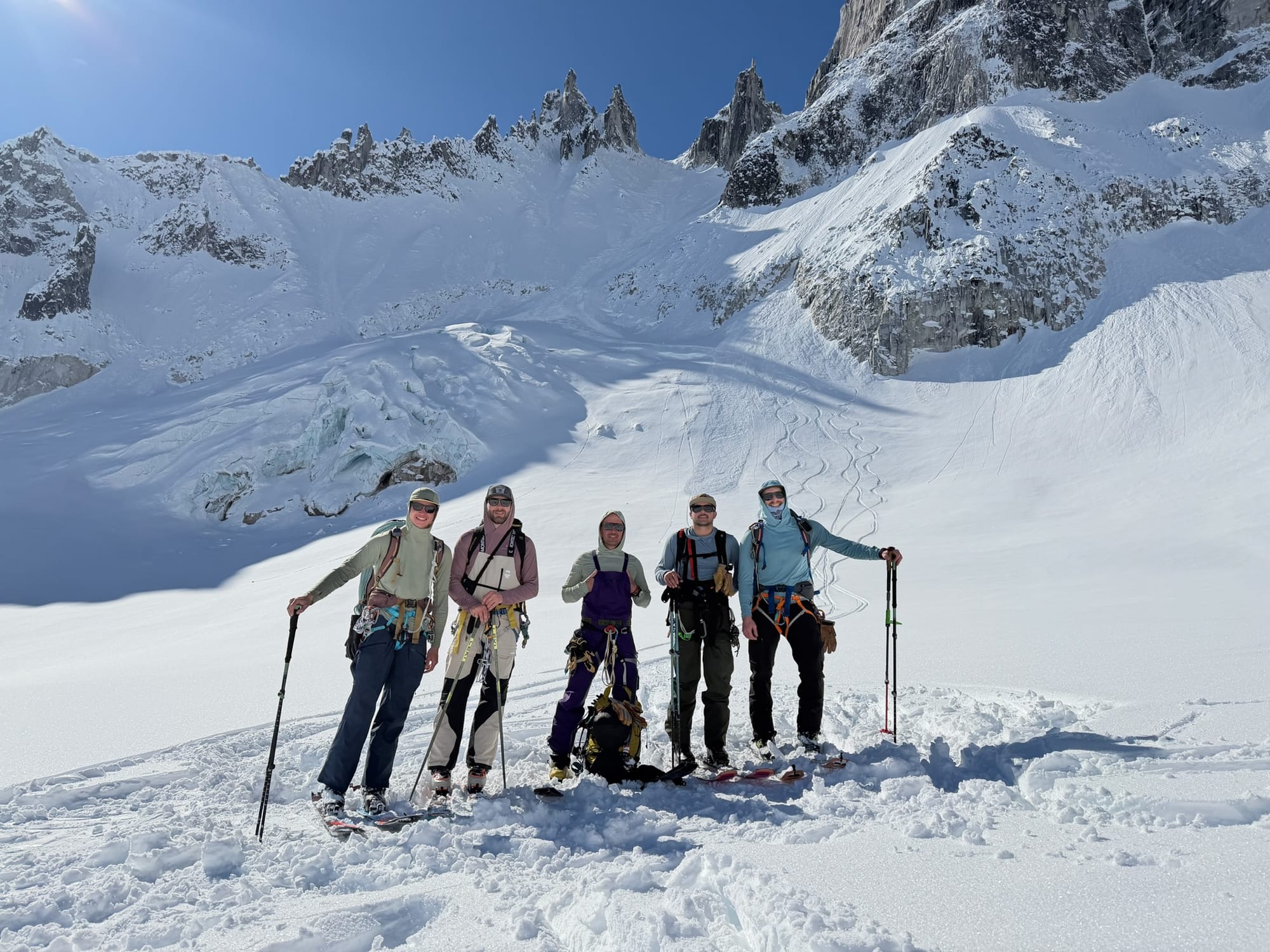
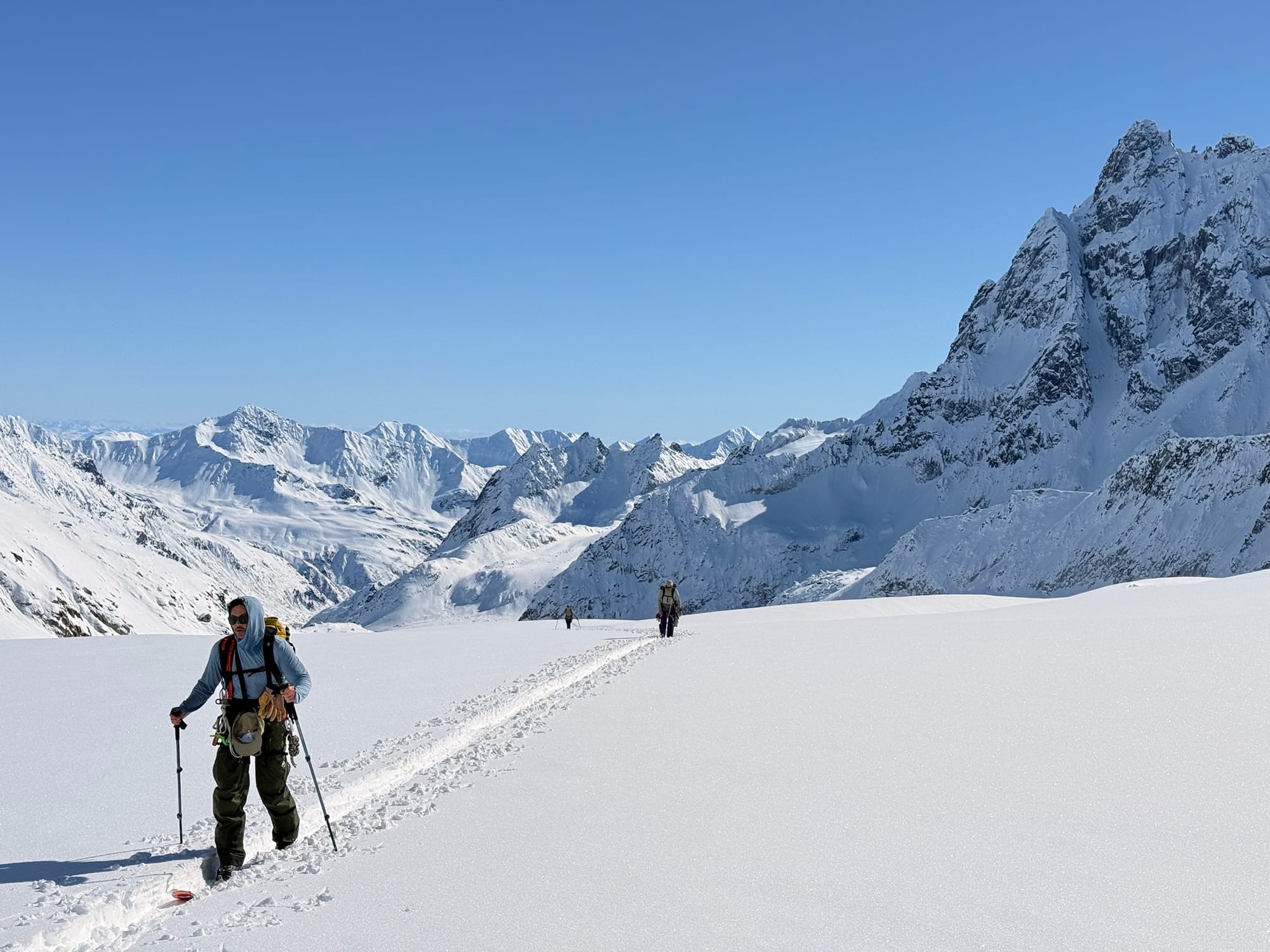
The Alaska Range doesn't offer many perfect days. The weather window has to cooperate, the snowpack has to behave, and the people around you have to be ready when both of those things happen at once. This February, two of our RMI guides, Seth Burns and Sam Hoffman, headed to the Pika Glacier on a private ski mountaineering trip with a small group of clients. What unfolded was the kind of day that reminds you why you do this in the first place. Here's Seth's account:
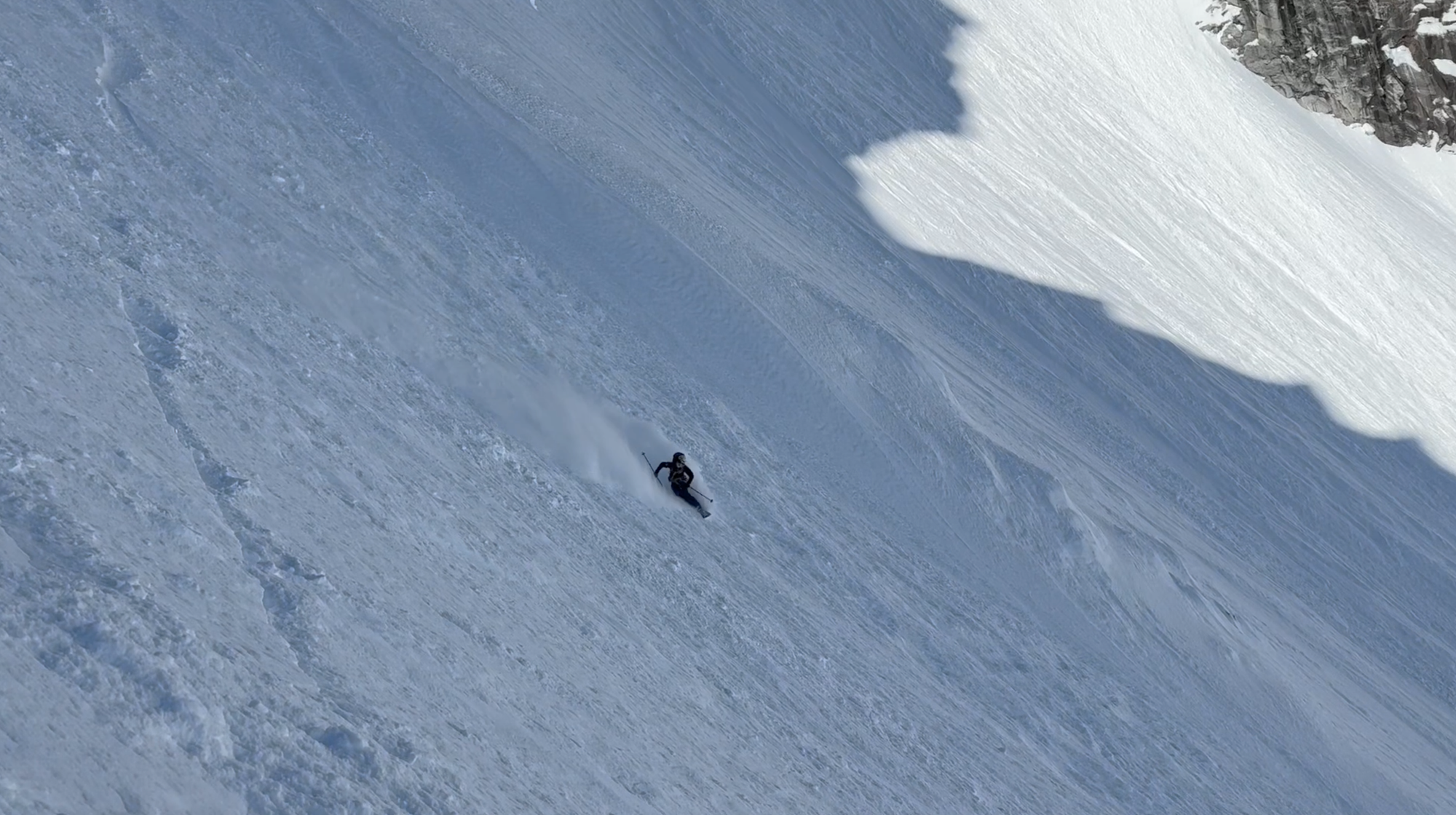
Dropping into the steep entrance of the Granite 2 couloir was instantaneous: two feet of settled powder swallowed the skis and the world narrowed to the steady rhythm of jump-turn, breathe, jump-turn. The first few turns were tight and controlled before the terrain opened up and the following arcs were pure suspension, soft snow spraying against the bright blue sky. It was one of those bluebird days where the light sharpens everything: the steep granite walls on either side, the jagged teeth of the Alaska Range, and the expanse of the glacier below. Being at the right place at the right time, getting to ski that kind of untouched snow in that terrain was a wonderfully rare and perfectly simple reward.
The approach to ski a line such as this is equal parts luck and honest work.
The Luck
After a gorgeous day to fly onto the Pika and set up camp, an exceedingly mellow snowstorm set in for two days. This storm brought 18 inches of low-density "cold smoke" snow that, as we say in the industry, "came in right side up" (meaning that as the storm progressed, the snow got progressively lighter). Perhaps more fortunate than the snow itself was the wind, or rather the lack of it. Over the course of those two days there was barely a whisper of wind among the falling flakes.
The Work
To ski a big Alaska line safely takes work, and ours started well before arriving on the Pika. Sam (my fellow guide on the trip) and I met our clients months before for a few days of backcountry skiing in the Wasatch. This got the entire group on the same page with regards to risk management and gave Sam and me confidence in everyone's skiing and riding ability.
Once on the Pika, the work continued: quick snow pits, terrain observations, a stepped progression of objectives, and systematic scouting were all required. As our confidence in both the snowpack and the crew grew, we set our sights on Granite 2, a consistent northwest-facing couloir with a steep entrance, an open face, and a somewhat complex glaciated exit.
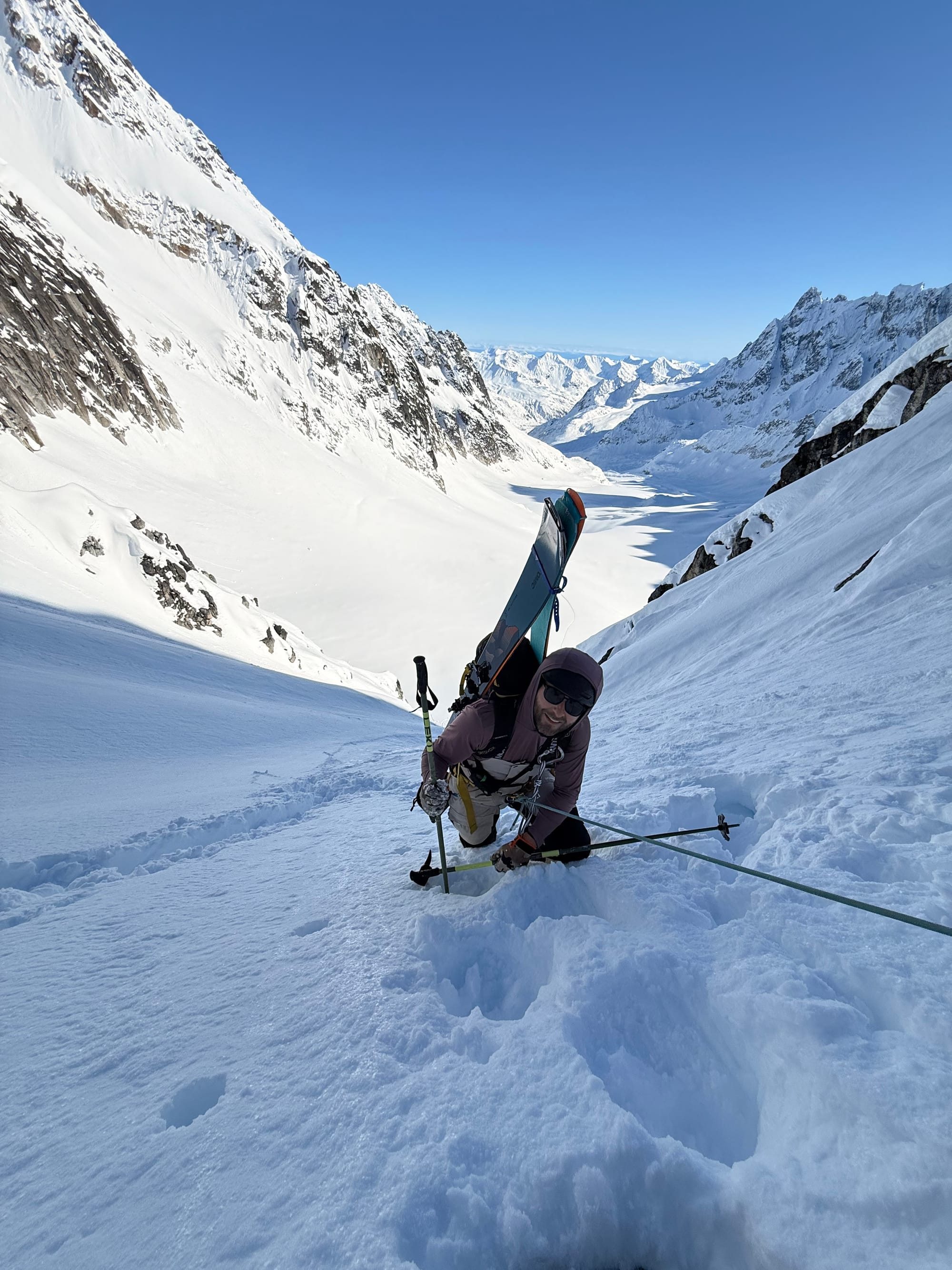
With preparation complete, the work continued with a skin up the backside of our objective. Once at the top, I built an anchor so Sam could perform a belayed ski cut (a standard mitigation tactic used to test for small, new snow avalanche problems). With no red flags present, we began what would turn into a magical descent.
The steep 50-plus-degree entrance presented a different calculus for each person. Some opted for an initial rappel, some a belayed ski, and others clicked in right from the top. Everyone listened to their own inner voice with regards to comfort and ability. Once in, by whatever means, the pure joy of deep settled powder on a steep and picturesque face was found by all.
The Payoff
The main section unfolded into long, pillowy turns as deep settled powder cushioned each arc. There was a playful, weightless bounce to the run: clean face shots, an effortless float, and the kind of grin that comes from skiing something that feels almost too good to be real. All of it balanced, as it has to be in this terrain, by mindful line choice and timing.
We dropped into a slower, more deliberate cadence as the slope eased and the glacier opened beneath us. The snow quality became more variable and the bergschrund approached. In this environment, every turn earns a second thought. Adrenaline is welcome; carelessness is not.
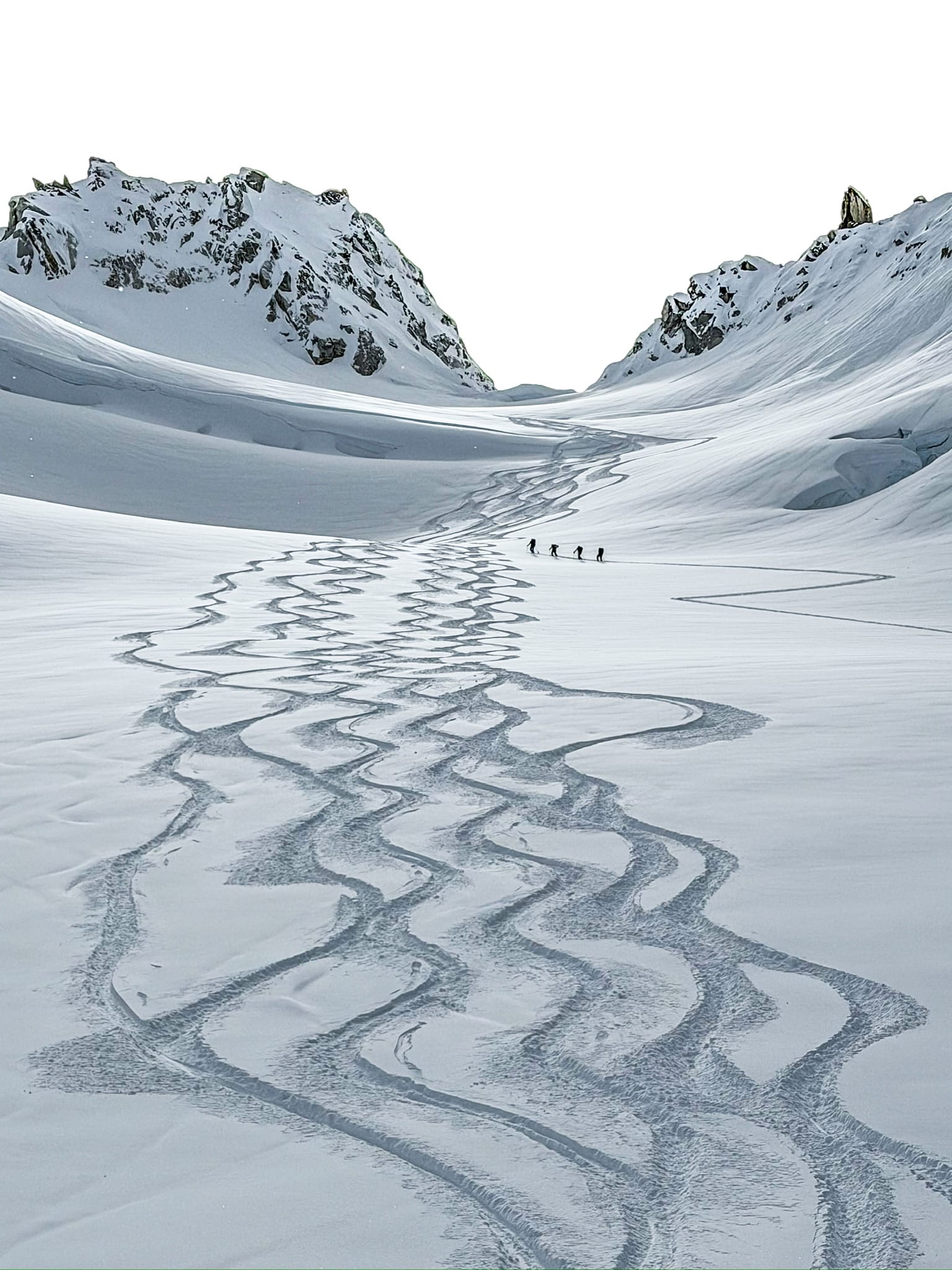
Looking up at the line from below, the granite walls framed a steep fall line cut only by our few tracks. The combination of stable snow, bottomless powder, and flawless visibility made the whole pitch feel improbably composed. In the Alaska Range, that rare alignment of factors — when everything behaves and timing lines up — comes around very rarely. Standing there, I couldn't help but feel humbled and grateful to have been a part of it.
Beyond the line itself, the trip was a full sensory Alaska experience: the mouth-watering smell of burgers from the cook tent, the distant roar of serac falls, the taste of cold air after a hard bootpack, and that incredible stillness at the top before you drop. The Range's scale makes everything feel small and temporary. Tracks fade fast in this environment.
For all the technical planning, the big takeaway was simple: a perfect line, deep settled snow, and a day in the Alaska Range that will not come around again quite like that. The soft hold of powder under skis is a feeling that sticks.
Stories like this one don't happen by accident. They're the product of years of experience reading mountains, managing risk, and knowing when conditions are finally asking you to go. Seth, Sam, and all our guides bring that same preparation and judgment to every RMI expedition. If the Pika has you thinking about your own Alaska adventure, we'd love to help you start planning. Explore our Alaska programs or reach out to our team to learn more.