


Whether you're eyeing your first major summit or adding another peak to your experience, this 16-week plan gives you the foundation to arrive at your climb ready. It's built on the same principles we use to prepare climbers for Mount Rainier, but it's flexible enough to adapt to whatever mountain you're chasing.
Inside, you'll find proven conditioning strategies paired with practical guidance on fueling, recovery, and skill development. The goal is simple: show up feeling fit, confident, and excited for what's ahead.
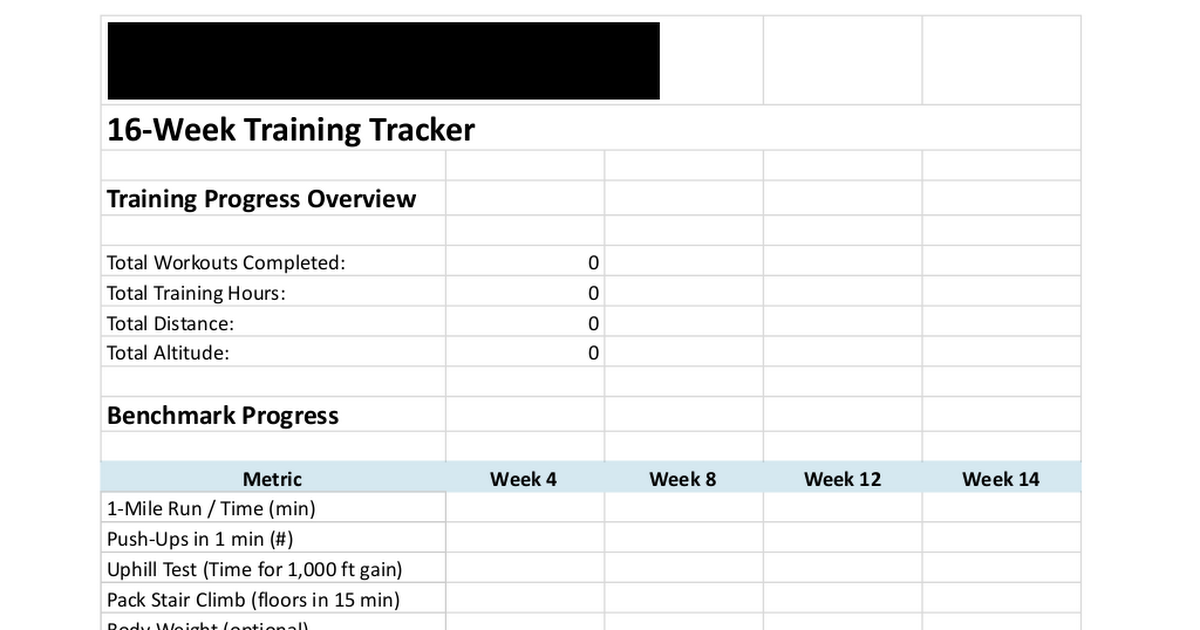
This article takes you through how to use our 16 Week Training Plan Template, which you can download as an Excel or Google Sheets file. If you're using Google Sheets, just click the link, then select File → Make a Copy to create your own editable version.

To get the most out of this plan, check out these RMI resources that dig deeper into the training concepts you'll be using:
- Creating a Custom Training Plan – Learn how to personalize your workouts based on your specific goals, timeline, and where you're starting from. We'll walk you through periodization, motor fitness, and aerobic development.
- The Importance of Benchmarking – Regular fitness tests (like uphill time trials or push-up counts) give you essential feedback on what's working. This guide helps you track progress and adjust your plan to keep improving.
- Finding a Training Community – Strengthen your mountaineering training with a community of like-minded climbers who motivate and share the journey. Join us and explore.
- Becoming "Bonk" Proof: Improving Fat Oxidation – Discover how to train your body to tap into fat stores for sustained endurance. Perfect for managing long summit days without burning through all your quick energy.
- Aerobic Base Training for Mountaineering – Develop your aerobic base for endurance, strength, and performance in alpine environments with RMI’s expert guidance. Level up your training today.
Setting Your Goals
Training goals are critically important given the time constraints placed by weather, route conditions, objective hazards, and the effects of altitude. Proper physical conditioning allows you to perform better by climbing longer, stronger and faster, be more comfortable on steeper and awkward terrain, carry heavier loads, recover more quickly at rest, and better enjoy the entire adventure.

Begin by asking these questions:
What is the fitness needed on the climb?
- How many days does the climb require?
- What type of terrain and climbing will you encounter?
- To what altitudes will you climb?
- How heavy a pack will you carry?
What is my current fitness?
- What are your current cardiovascular strengths and weaknesses?
- What are your current motor fitness strengths and weaknesses?
What is my time frame?
- How long do you have to improve your fitness before the start of the climb?
Overview of Phases
This 16-week plan breaks down into four phases: Base Fitness, Mountaineering-Specific, Peak Simulation, and Taper & Recovery. You'll gradually build aerobic capacity, strength, and the mountain-specific skills you need. Each week includes suggested workouts, nutrition tips, and space to log your own details.
The keys to success? Consistency, smart fueling, and regular performance checks.
Phase 1: Base Fitness (Weeks 1 to 4)
Primary Goal: Build a broad aerobic base and basic strength.
Typical Workouts: Easy runs/hikes, foundational strength work (bodyweight squats, lunges, push-ups), mobility sessions.
Nutrition Emphasis: Increase daily protein, make sure you're getting adequate carbs for moderate-intensity aerobic sessions.
Phase 2: Mountaineering-Specific (Weeks 5 to 10)
Primary Goal: Add interval training, weighted pack hikes, and skill practice (balance, stepping technique, basic footwork).
Typical Workouts: Hill repeats, speed hikes, progressive pack weight.
Nutrition Emphasis: Refine your fueling strategy. Start incorporating more calorically dense snacks, experiment with fasted easy sessions if you want.
Phase 3: Peak Simulation (Weeks 11 to 14)
Primary Goal: Longer hikes (multiple hours), heavier packs, possibly back-to-back long days to simulate real climb conditions.
Typical Workouts: 4 to 8 hour hikes on weekends, continued intervals, advanced strength sessions.
Nutrition Emphasis: Practice your "summit day" eating and drinking schedule. Make sure you can handle real trail snacks and meals.
Phase 4: Taper & Recovery (Weeks 15 to 16)
Primary Goal: Significantly reduce training volume (around 50%) so you arrive at your climb feeling rested, not fatigued.
Typical Workouts: Brief, low-intensity hikes, final gear checks, mental prep.
Nutrition Emphasis: Maintain healthy calorie intake without the heavy training load. Focus on hydration, micronutrients, and rest.
Core Components & Guidelines
To get ready for your climb, you'll want to hit five key areas: aerobic endurance, anaerobic/interval work, strength training, balance/agility, and flexibility/mobility. Each one builds a different piece of your overall fitness, helping you handle long days, steep sections, heavy packs, and quick recovery.
AEROBIC ENDURANCE

- Definition: In order to train for the exhausting days in the mountains, you’ve got to get out and do lengthy training climbs; nothing else will prepare you as adequately.
- Purpose: Build your aerobic training over time, beginning with shorter sessions and increasing to longer workouts. By the time your climb approaches, you should feel comfortable with an aerobic exertion that is similar to any day of your anticipated climb. Don’t forget to prepare for the downhills too by training on varied terrain and developing your aerobic ability for the descent.
- Recommendations: At least 30 minutes of aerobic training per session. Keep your training range at 65 to 85% of your maximum heart rate. Subtract your age from the number 220 (beats per minute).
ANAEROBIC / INTERVAL WORK

- Definition: Interval training, used over a long period of time, can increase the heart’s capacity for pumping blood through the body. We have had success with interval training when we have a minimum of three months of training time.
- Purpose: Interval training is an important component in improving your cardiovascular base and preparing to climb comfortably at a variety of paces. The technique of interval training calls for including surges in activity while maintaining an elevated heart rate.
- Recommendations: 5-minute running intervals. 30-minute time trials riding a bike. Speed hikes lasting up to an hour. See more on Interval Training here.
STRENGTH TRAINING

- Definition: Strength training principles are essentially the same for upper and lower bodies. Strength training can involve body weight exercises as well as routines using traditional weights.
- Purpose: In addition to leg strength, mountaineering requires a strong core (back and stomach) as heavy pack weights add a new dimension to climbing.
- Recommendations: Squats, lunges, and leg presses. Push-ups, pull-ups, and military presses. Sit-ups and abdominal exercises
BALANCE & AGILITY

- Definition: Balance is a motor skill and can be improved over time. Distinguish between static and dynamic balance exercises. Static exercises will keep one or both feet on the ground. Dynamic exercises involve the body in motion. Both are important for the development of this fitness skill.
- Purpose: Balance exercises give you increased body awareness and aid in your ability to negotiate tricky terrain under a heavy pack.
- Recommendations:
- STATIC: Standing on one leg. Standing on one leg with eyes closed.
- DYNAMIC: Walking a line (with and without eyes closed). Walking on an elevated rope (slacklining).
FLEXIBILITY & MOBILITY

- Definition: Stretching, foam rolling, yoga, or similar practices.
- Purpose: Reduce injury risk and improve recovery between workouts.
- Recommendations: Focus on slow, static stretching and hold the stretch for 30 to 60 seconds, breathing through the stretch. Hold it only to the point of tension.
Stretch all parts of your body, not only your legs. Carrying a heavy pack often puts unexpected strain on your neck, shoulders, and back in addition to fatiguing your legs.
Nutrition Planning
Mountaineering training places high demands on your body. Good nutrition ensures stable energy levels, supports muscle recovery, and helps prevent fatigue or injury.

Macronutrient Focus
- Carbs: Main source of quick energy, especially for interval or high-intensity work.
- Protein: Helps repair and build muscle. Aim to include a solid protein source at each meal.
- Healthy Fats: Provide long-lasting energy, especially beneficial for multi-hour hikes and endurance efforts.
Mid-Workout Fueling & Hydration
For efforts over 1 hour, plan your snack options (fruit, energy gels, bars, trail mix) and decide how often you'll eat (typically every 45-60 minutes). Note a hydration target per hour (e.g., 10-12 oz) and whether you'll use electrolyte tabs or sports drink.
Ongoing Adjustments
Throughout the 16 weeks, reevaluate how well your nutrition plan is supporting training. Experiment early in the plan to see what works best. By logging your observations, you'll develop a reliable system to keep you fueled, recovered, and ready for each step toward your summit.
Using the Weekly Tables
Each week includes a table with suggested workouts and space for you to fill in your own details. Think of these as a framework, not a script. Here's what each column is for:
Suggested Workout: We provide a recommended structure (like "Strength & Mobility" or "Interval Hike").
Your Plan: Fill in the actual details. Duration, pack weight, location, intensity level. Make it yours.
Nutrition Notes: Jot down how you'll fuel before, during, or after workouts. This helps you dial in what works.
Progress Notes: Optional space for reflection. How you felt, any gear issues, adjustments you made. Tracking patterns here is valuable.
Progress Tracking
Use this table to log your benchmark test results every few weeks. Watching these numbers improve is one of the best motivators out there.
Week 1 (Phase 1: Base Fitness)
Focus:
- Establish workout routine, ease into consistent training.
- Begin tracking hydration and sleep patterns.
Nutrition Focus:
- Build awareness around meal timing relative to workouts.
- Focus on whole foods, adequate protein.
Week 2 (Phase 1: Base Fitness)
Focus:
- Maintain routine, slightly increase aerobic volume.
- Continue basic strength, add small incremental challenges (5 more minutes to each session).
Nutrition Focus:
- Assess fueling during longer weekend hike.
- Include daily fruit/vegetable servings, focus on micronutrients.
Week 3 (Phase 1: Base Fitness)
Focus:
- Continue building aerobic base.
- Add variety to strength work (different exercises, slight progressions).
Nutrition Focus:
- Experiment with pre-workout snacks, note what works.
- Track energy levels throughout the day.
Week 4 (Phase 1: Base Fitness)
Focus:
- Peak volume for base phase.
- Run first benchmark tests if possible (1-mile, push-ups, etc).
Nutrition Focus:
- Fine-tune daily hydration and meal timing.
- Prepare for next phase (more intensity).
Week 5 (Phase 2: Mountaineering-Specific)
Focus:
- Introduce intervals (hill repeats or speed work).
- Start adding light pack weight (10 to 15 lbs) to weekend hikes.
Nutrition Focus:
- Fuel intervals with quick-digesting carbs pre-workout.
- Test calorically dense snacks on longer efforts.
Week 6 (Phase 2: Mountaineering-Specific)
Focus:
- Progress interval intensity or duration slightly.
- Increase pack weight to 15 to 20 lbs.
Nutrition Focus:
- Refine pre-workout fueling strategy.
- Track how you feel during intervals vs. long hikes.
Week 7 (Phase 2: Mountaineering-Specific)
Focus:
- Maintain interval work.
- Continue building pack weight tolerance.
Nutrition Focus:
- Dial in your go-to trail snacks.
- Stay consistent with hydration (around 16 oz/hr on longer hikes).
Week 8 (Phase 2: Mountaineering-Specific)
Focus:
- Increase pack weight (20 to 25 lbs).
- Continue intervals, build endurance base.
Nutrition Focus:
- Refine fueling strategy, aim for 200 to 250 kcal/hr on long hikes.
- Hydration: around 16 to 20 oz/hr depending on conditions.
Week 9 (Phase 2: Mountaineering-Specific)
Focus:
- Peak volume for this phase.
- Optional: second benchmark test to track progress.
Nutrition Focus:
- Assess what's working, adjust as needed.
- Start thinking about summit day fueling strategy.
Week 10 (Phase 2: Mountaineering-Specific)
Focus:
- Slight recovery week before ramping to peak simulation.
- Reduce volume around 20% from Week 9.
Nutrition Focus:
- Maintain quality, reduce total calories slightly if volume drops.
- Focus on recovery foods (lean protein, veggies).
Week 11 (Phase 3: Peak Simulation)
Focus:
- Longer hikes (4 to 6 hrs), heavier packs (30 to 35 lbs).
- Simulate summit day conditions where possible.
Nutrition Focus:
- Practice summit day fueling: small, frequent snacks.
- Target 250 to 300 kcal/hr on long efforts.
Week 12 (Phase 3: Peak Simulation)
Focus:
- Continue building endurance with long weighted hikes.
- Optional: third benchmark test.
Nutrition Focus:
- Refine your summit day nutrition plan.
- Test different snack combinations.
Week 13 (Phase 3: Peak Simulation)
Focus:
- Maintain long hike volume, heavy pack.
- Focus on mental preparation and pacing.
Nutrition Focus:
- Practice eating when you're not hungry.
- Stay consistent with hydration even in cool weather.
Week 14 (Phase 3: Peak Simulation)
Focus:
- Peak volume week. Consider back-to-back long days (Saturday/Sunday).
- Heaviest pack weight (35 to 40 lbs), steepest terrain available.
Nutrition Focus:
- Start cutting out junk miles and junk calories. Focus on quality.
- Hydrate thoroughly if you're doing big back-to-back hikes.
Week 15 (Phase 4: Taper & Recovery)
Focus:
- Reduce overall volume around 50%. Maintain short intervals or easy hikes to keep legs active.
- Let the body fully recover before the climb.
Nutrition Focus:
- Keep quality high but watch total calories if activity is dropping.
- Emphasize micronutrients, anti-inflammatory foods (berries, leafy greens).
Week 16 (Phase 4: Taper & Recovery)
Focus:
- Keep activity minimal. Just enough to stay loose.
- Triple-check gear, finalize logistics.
Nutrition Focus:
- Avoid untested foods. Eat what you know works.
- Hydrate thoroughly in the days leading up to the climb.
Final Notes & Tips
Customize Load & Duration: The suggested workouts are guidelines. Scale up or down based on your fitness, local terrain, and schedule.
Listen to Your Body: If fatigue piles up or you feel soreness/injury coming on, reduce volume or intensity. Prioritize rest.
Track Nutrition: Keep a log of what works best, especially on long hikes. Show up at your climb with a proven fueling strategy.
Stay Flexible: Work, weather, and life can shift your plan. Consistency over time beats perfection every time.
Enjoy the Journey: Building mountaineering fitness is challenging and rewarding. Celebrate the gains, learn from setbacks, and have fun with it.
This 16-week program gives you a structured, progressive plan you can adapt to your schedule and objective. Use the template to track your progress, dial in your nutrition, and build the fitness you need. Train well, and we'll see you on the mountain.
